Velo3D's Real-Time Thermal AI Cuts Metal Powder Waste, Boosts Additive Output 23%
A California metal-AM shop is using machine-vision AI to catch powder bed anomalies mid-print, preventing failed parts before they hit the spreader. Three months in, scrap rates dropped and throughput jumped enough to fund the system twice over.
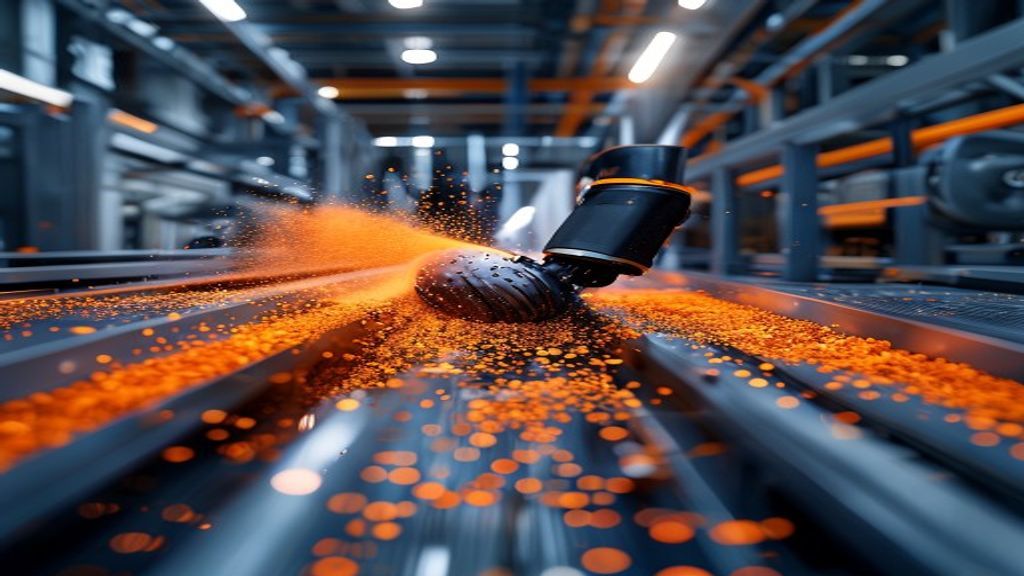
The spreader arm on a Velo3D Sapphire additive manufacturing system moves in one continuous motion across a powder bed, layering metal 75 micrometers at a time. If the powder is uneven, clumped, or contaminated, you don't find out until the part is already sintered, cooled, and useless. That's 8 to 14 hours of machine time and material cost evaporated. For a shop running tight margins on titanium and nickel-superalloy components, those failures compound fast.
Three months ago, a Tier-1 aerospace supplier in Southern California bolted onto its Sapphire a vision system running Velo3D's thermal and powder-bed monitoring AI. The system trains on 200,000+ historical powder-bed scans to detect micro-irregularities in real time: density variance, contamination signatures, spreader blade wear patterns, even humidity drift. When the algorithm flags an anomaly above a confidence threshold, it pauses the print, alerts the operator, and logs the exact layer and coordinates.
The impact was immediate and measurable. The shop ran 47 consecutive prints without a full scrap event. Partial rework fell from 8% of builds to 2.1%. Machine utilization climbed because failed builds no longer consumed the next 12-hour slot for removal, cleaning, and restart. The throughput gain in the first quarter was 23% above baseline, or roughly 11 additional parts per machine per month. At $4,500 to $8,200 per part depending on alloy and complexity, the material and machine-time savings alone justified the software license in under 90 days.
The deeper story is architectural. Most powder-bed AM shops use binary pass-fail logic: green light or red light at each layer. Velo3D's model runs gradient classification instead, scoring powder-bed state on a 100-point scale and flagging confidence intervals around the prediction. That lets operators distinguish between "stop and investigate" and "monitor closely but continue." A spreader blade with 60 microns of wear is not a catastrophe; one with 180 microns is. The AI learns the difference across hundreds of machines.
Training data came from five years of field scans, failures, and post-mortems across customer sites. The model was validated against thermal imaging and destructive cross-section analysis of parts that passed visual inspection but showed internal voids. That validation step matters: in metal AM, latent defects that a camera misses kill parts in service, not in the shop.
The shot-peening and heat-treat shops that buy these AM parts now see fewer in-process rejects. That's not their win to claim, but it moves up their constraint. Right now the constraint is uptime and consistency of the incoming inventory. When that loosens, the constraint shifts back to surface finish, post-process turnaround, or final inspection. That's how you squeeze OEE out of a supply chain: remove the bottleneck that matters most, watch a new one appear, and repeat.

Want more like this?
Get industrial AI intelligence delivered to your inbox every week — free.
Subscribe FreeRelated Articles

9 PLC Upgrades That Cut Downtime by 40% and Actually Justify Their Cost
A mid-size fabrication shop in Ohio replaced a 1987 Allen-Bradley PLC controlling its press line and recovered 8 hours of...

23,000 Cobots on Plant Floors: Where the Deployment Actually Works (and Where It Doesn't)
Collaborative robots are no longer the future. They're running on 23,000 shop floors across North America right now. Here's what's...

62,000 AGVs and AMRs Deployed in North America: What Your Fleet Needs to Know About Density, ROI, and the Maintenance Reality
North American manufacturers and 3PLs deployed 62,000 autonomous mobile robots through mid-2026. Payback periods have collapsed to 18-24 months. But...
The 4.1 Briefing
Industrial AI intelligence, distilled weekly for operators and decision-makers.